Core Benefits of Pillar Jib Crane for Small-Space Operations
Pillar jib cranes stand out in modern industrial production primarily because they solve the common pain point of insufficient workshop space. Their structural and operational advantages are highly targeted for small-scale, fixed-station lifting work, bringing tangible efficiency and cost benefits to enterprises.
1.Ultra-Compact Standalone Structure Saves Valuable Workshop Space
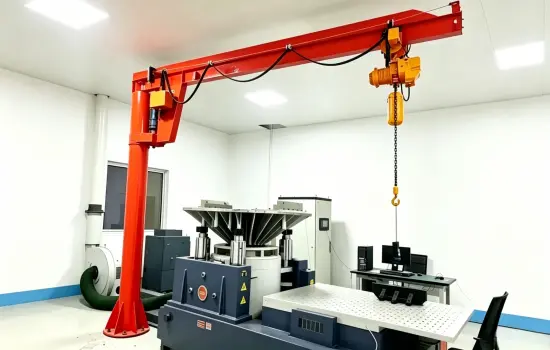
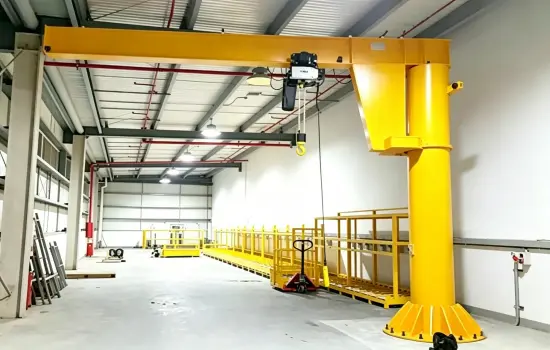
The entire pillar jib crane relies on an independent ground-fixed column for support, requiring no wall attachments, building frame reinforcement, or runway beam installation. It occupies minimal floor area and does not block worker passages, production equipment layout, or material transportation routes. For small factories, narrow processing zones, and densely arranged assembly workshops where large cranes cannot be installed, this space-saving design perfectly fills the gap of on-site lifting capacity.
2.360° Flexible Rotation Achieves Omnidirectional Lifting Coverage
Standard
pillar jib cranes support smooth, free 360-degree rotation, forming a complete circular working coverage area centered on the vertical column. Matched with the electric hoist’s horizontal traversing and vertical lifting functions, the equipment can flexibly pick, place, and transfer materials in corner edges, dead zones, and compact station areas that traditional large cranes cannot reach. It realizes all-round localized material handling and greatly improves the utilization rate of limited workshop space.
3.High Efficiency for Repetitive Short-Distance Handling
Most small-space industrial lifting work features short distance, fixed stations, and high frequency. Manual handling is labor-intensive and low-efficiency, while deploying large cranes is cumbersome and energy-wasting. Pillar jib cranes adopt electric driving for rotation and lifting, which effectively reduces manual labor, speeds up workpiece loading and unloading, mold replacement, and parts transferring, and significantly improves the overall operational efficiency of compact production stations.
4.Simple Installation and Flexible Layout Adaptability
Featuring an integrated modular assembly structure, pillar jib cranes only require simple foundation fixing and basic electrical commissioning for installation. No complicated civil engineering, factory renovation, or track laying is needed. The whole machine can be quickly put into use or relocated according to production adjustments, offering extremely high flexibility for small and medium-sized factories with variable production layouts and limited site conditions.
5.Excellent Cost-Performance with Low Long-Term Operating Costs
Compared with overhead cranes and gantry cranes,
pillar jib cranes have lower initial procurement costs, simpler mechanical structures, and fewer vulnerable parts. The daily maintenance work is limited to regular inspection, lubrication, and electrical checking, with negligible maintenance expenses. For small enterprises, independent processing stations, and auxiliary production links, it is an ideal low-investment and high-return lifting device.
6.Complete Safety Mechanism Ensures Stable Workshop Operation
Equipped with industrial-grade safety configurations including overload protection device, upper and lower travel limit switches, anti-collision buffers, and instant braking system, pillar jib cranes effectively prevent overloading, over-traveling, and cargo falling risks. The thickened steel column and jib beam enhance structural rigidity, ensuring stable and shake-free lifting during frequent operation, and fully guarantee the safety of personnel and equipment in crowded small workshops.
Main Industrial Application Scenarios
Thanks to its space-saving design and flexible operation, the
pillar jib crane is widely applicable in various confined working scenarios where traditional heavy lifting equipment is unavailable:
1.Compact Mechanical Processing Workshops
It is perfectly matched for auxiliary handling of lathes, milling machines, drilling machines and other processing equipment, realizing fast loading and unloading of small and medium-sized metal workpieces in narrow station spaces, and improving processing continuity.
2.Fixed Assembly Line Stations
Used for precise assembly, parts feeding, and finished product handling on automated and semi-automated assembly lines. It solves the problem of inconvenient material handling at fixed stations and optimizes production rhythm.
3.Small Warehouses and Storage Zones
Suitable for short-distance stacking, sorting and loading of heavy goods in narrow indoor storage areas, making up for the space limitation of large lifting equipment and improving warehouse storage and handling efficiency.
4.On-Site Equipment Maintenance and Workshop Renovation
Ideal for daily mechanical maintenance, component replacement, and small-scale engineering lifting in confined factory spaces. It features flexible operation and strong adaptability to temporary working needs.
Professional Selection Guide for Small-Space Pillar Jib Crane
To avoid improper selection leading to insufficient lifting capacity or space waste, enterprises can select the most suitable model based on the following practical standards:
1.Reasonably Configure Lifting Tonnage
Small-space lifting is dominated by light and medium loads. Conventional 0.5 ton to 5 ton
pillar jib cranes can meet most workshop production and maintenance needs. It is recommended to reserve 10%–20% load margin during selection to avoid long-term overload operation and extend equipment service life.
2.Match Jib Length and Lifting Height According to Site Conditions
Determine the jib arm length based on the actual operating radius of the working station to prevent an overlong jib from occupying limited workshop space. Meanwhile, configure the maximum lifting height according to the indoor ceiling height to ensure unobstructed vertical lifting and avoid space constraints.
3.Choose Operation Mode Based on Working Frequency
For occasional intermittent maintenance and light-load operation, manual rotating jib cranes are more economical and practical. For daily high-frequency repetitive handling work, full-electric rotating and lifting models can greatly save labor and improve production efficiency.
4.Customize Surface Treatment According to Environment
Standard anti-rust painting is sufficient for dry and clean indoor workshops. For humid, dusty, or slightly corrosive working environments, upgraded wear-resistant and anti-corrosion coating is recommended to enhance weather resistance and prolong the equipment’s service cycle.
Frequently Asked Questions
Q1: Can pillar jib cranes work normally in extremely narrow workshops?
A: Yes. The standalone floor-fixed structure occupies almost no operating space, and the 360° rotating jib can flexibly adapt to narrow stations, corner areas and compact production zones. It is the preferred lifting equipment for small-space industrial workshops.
Q2: Is the installation process of pillar jib crane complicated?
A: No. The equipment adopts integrated modular design with pre-assembled core components. On-site installation only requires foundation fixing and simple electrical debugging, with short construction period and no damage to the original workshop structure.
Q3: What is the difference between pillar jib crane and wall mounted jib crane?
A: A
pillar jib crane is independently fixed on the ground with a vertical column, requiring no wall support. It can be placed freely in the workshop center, corners or working stations. In contrast, wall mounted jib cranes must rely on factory walls or concrete pillars for installation. For small spaces with no available wall mounting points, the pillar jib crane is a more flexible and applicable option.
Conclusion
As a compact, flexible, and high-efficiency lifting device tailored for cramped working environments, the pillar jib crane perfectly solves the space shortage and low-efficiency problems of traditional lifting equipment in small workshops. It saves valuable factory space, reduces manual labor costs, and delivers stable and safe localized material handling performance. With low investment, simple installation and minimal maintenance requirements, the pillar jib crane has become a highly cost-effective lifting solution for small and medium-sized manufacturing enterprises, processing stations and assembly lines. If you need customized tonnage, jib length, lifting height or factory wholesale price of pillar jib cranes for your small-space working scenarios, feel free to
contact our professional lifting equipment team for reliable one-stop solutions.